
Why Technology Projects Succeed or Fail with People
Most organizations do not struggle because they picked the wrong technology.
More often, they struggle because people are not prepared to embrace the change.
A new application can be technically perfect.
A cybersecurity initiative can be well designed.
An AI solution can be thoughtfully implemented.
If employees do not understand the purpose, receive the right training, or believe the change will help them succeed, adoption suffers and value is lost.
Technology changes systems. Leadership changes organizations.
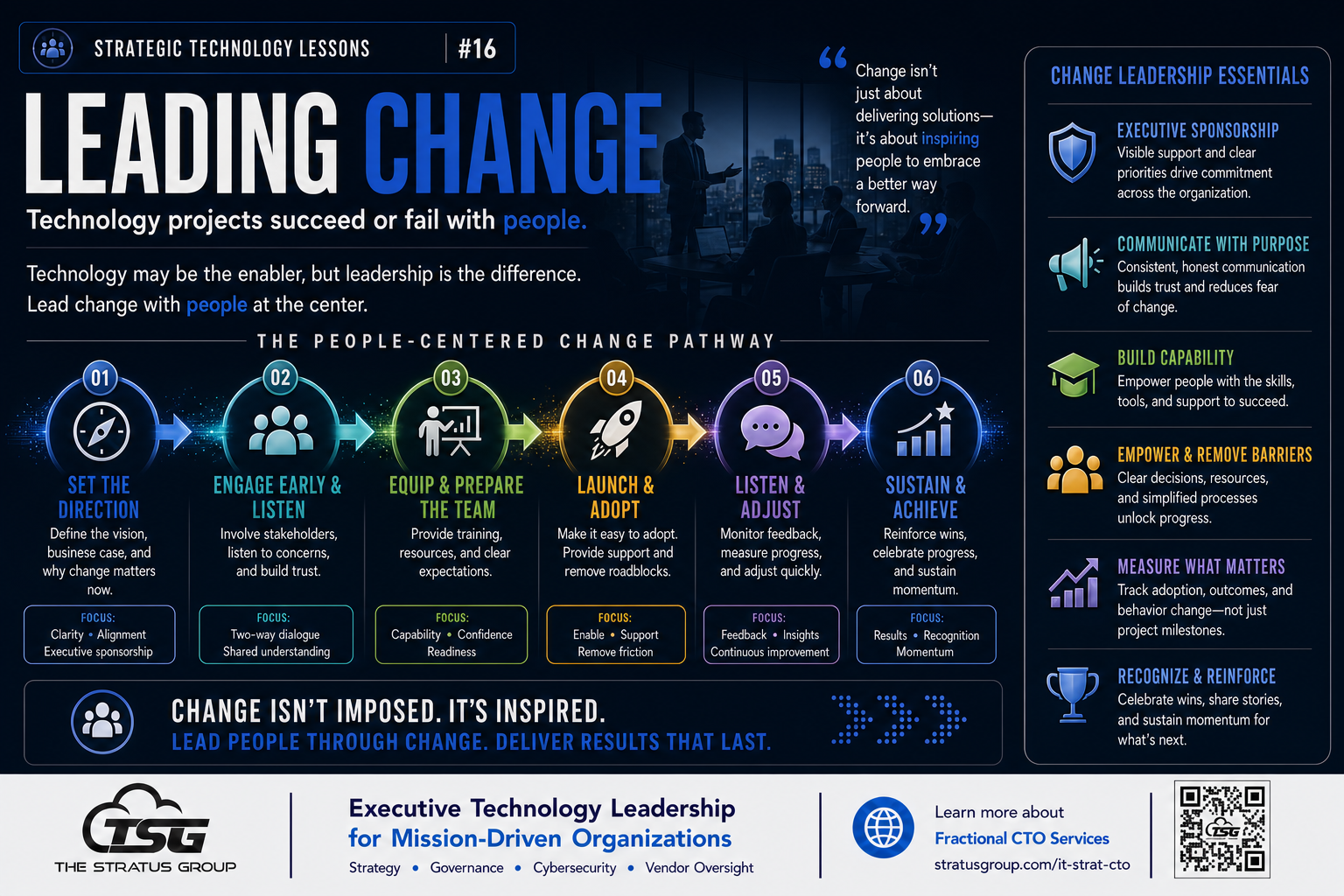
In Brief
Successful technology initiatives require more than project management.
They require change leadership.
The organizations that handle technology projects well usually focus on:
Executive sponsorship
Clear communication
Employee engagement
Practical training
Measurable adoption
Continuous feedback
Technology implementation ends on a go-live date.
Change leadership continues until new behaviors become routine.
Why Resistance Happens
People rarely resist technology itself.
They resist:
Uncertainty
Poor communication
Loss of familiar processes
Insufficient training
Lack of visible leadership
Fear of making mistakes
Recognizing these concerns early helps leaders build trust instead of frustration.
The Change Leadership Framework
1. Explain Why
Connect the initiative to the organization's mission and goals.
2. Involve People Early
Seek feedback before major decisions are finalized.
3. Equip the Team
Provide training, documentation, and ongoing support.
4. Measure Adoption
Track whether people are actually using new capabilities.
5. Reinforce Success
Celebrate progress, address obstacles, and continuously improve.
Common Mistakes
Announcing change too late
Treating training as a one-time event
Measuring project completion instead of adoption
Assuming technology alone changes behavior
Failing to communicate executive commitment
Executive Technology Check
Ask your leadership team:
Do employees understand why this change matters?
Have we identified champions across the organization?
How will we measure adoption, not just deployment?
What support will people need after go-live?
Are leaders modeling the behaviors they expect?
Key Takeaways
Successful technology projects are leadership initiatives.
Communication is as important as implementation.
Adoption determines ROI.
Change requires reinforcement, not just deployment.
Organizations that lead change well realize greater value from every technology investment.
Closing Thought
Technology projects are remembered less for the day they launched than for the way they changed how people work.
The organizations that lead change with clarity, empathy, and purpose achieve results that last long after implementation.
Continue the Conversation
The Stratus Group helps mission-driven organizations lead successful technology initiatives through executive strategy, governance, change leadership, and Fractional CTO services.
Learn more:
https://www.stratusgroup.com/it-strat-cto
Next in the Series
Strategic Technology Playbook #17 - Building High-Trust Technology Teams