
Why Information Alone Doesn't Improve Organizational Performance
Most organizations have more data than ever before.
Financial reports.
Fundraising systems.
Constituent databases.
Cloud applications.
Cybersecurity dashboards.
Operational metrics.
The challenge is no longer collecting information.
The challenge is turning information into insight.
Data is an asset. Insight is the advantage. Decisions create the impact.
In Brief
Technology gives organizations access to enormous amounts of information.
Unfortunately, more data does not automatically produce better decisions.
Organizations turn data into useful executive insight when they combine:
Trusted information
Clear governance
Meaningful metrics
Executive dashboards
Organizational context
The goal is not simply to report what happened.
The goal is to make better decisions about what happens next.
Why More Data Isn't the Answer
Many organizations struggle with:
Multiple versions of the truth
Disconnected applications
Manual spreadsheets
Duplicate reporting
Inconsistent metrics
Information overload
Leadership spends valuable time debating the accuracy of the data instead of discussing the implications.
The problem is rarely a lack of information.
It is a lack of clarity.
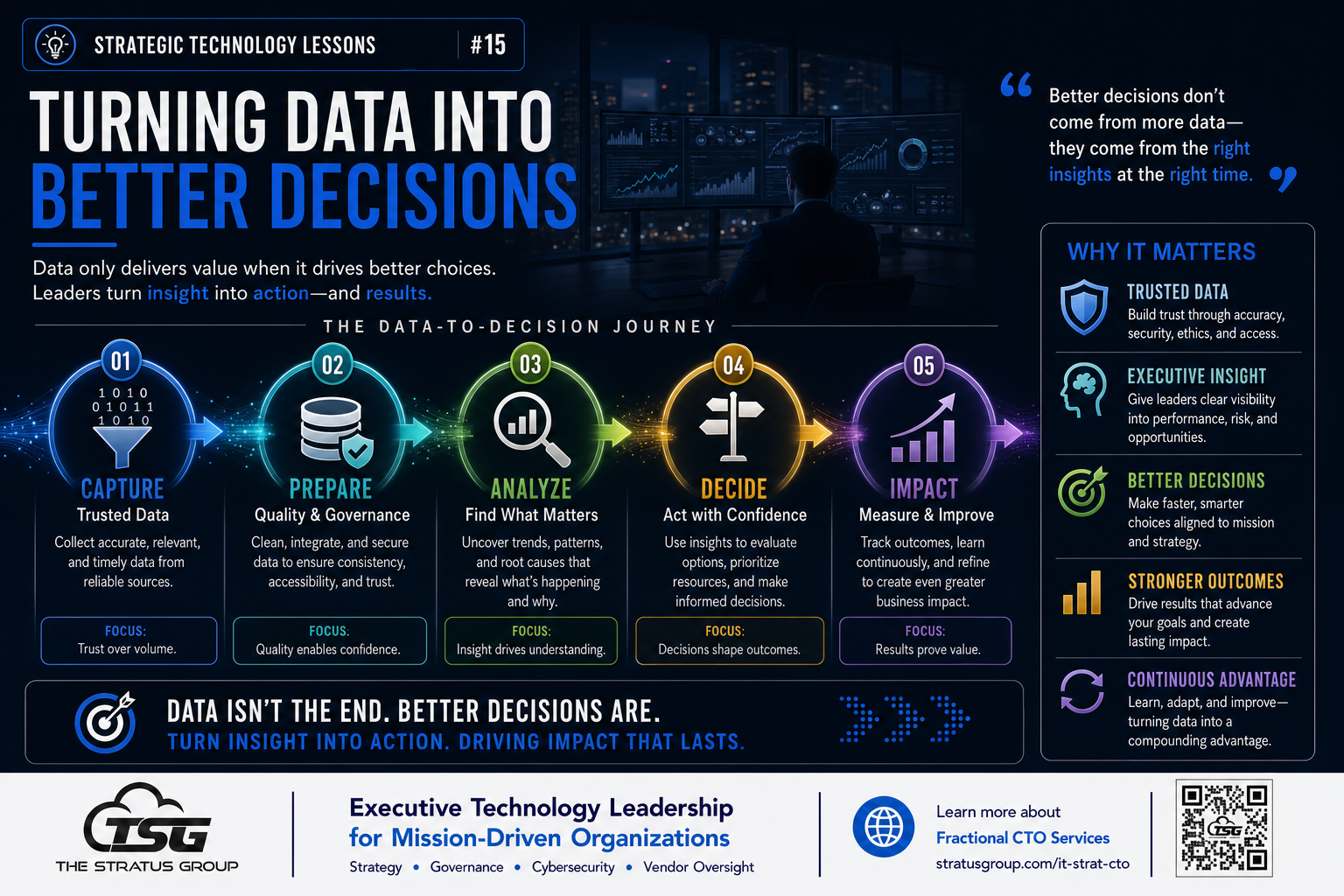
The Data-to-Decision Framework
High-performing organizations follow a simple progression.
1. Collect
Gather accurate information from trusted systems.
2. Organize
Create consistent definitions and governance.
3. Analyze
Identify trends, risks, and opportunities.
4. Decide
Use insight to guide strategic priorities.
5. Improve
Measure outcomes and refine future decisions.
Data becomes valuable only when it changes behavior.
Characteristics of Decision-Ready Organizations
Organizations that make strong decisions on a regular basis tend to do a few things well:
Trust their data.
Define common metrics.
Use executive dashboards.
Review trends, not isolated events.
Connect technology metrics to mission outcomes.
Measure progress over time.
Their conversations focus less on data collection and more on organizational improvement.
Executive Technology Check
Ask your leadership team:
Do we trust the information we use to make strategic decisions?
Are our reports consistent across departments?
Which executive dashboards influence board discussions?
Are technology investments improving data quality?
What decisions would improve if we had better information?
Key Takeaways
Data alone creates little value.
Insight comes from governance, consistency, and analysis.
Better information leads to better leadership decisions.
Executive dashboards should support action, not simply reporting.
Technology creates value when it improves organizational decision-making.
Closing Thought
Organizations do not succeed because they collect more data.
They succeed because they consistently make better decisions.
Technology's greatest contribution may not be automation.
It may be clarity.
Continue the Conversation
The Stratus Group helps mission-driven organizations strengthen data governance, executive reporting, technology strategy, and decision-making through Fractional CTO leadership.
Learn more:
https://www.stratusgroup.com/it-strat-cto
Next in the Series
Strategic Technology Playbook #16 - Leading Change: Why Technology Projects Succeed or Fail with People