
Vendor Accountability - STL #9
Who Represents Your Organization?
Most mission-driven organizations rely on multiple technology vendors.
A managed service provider, cybersecurity providers, cloud platforms, software vendors, telecommunications companies, consultants, and application providers all play important roles.
Each brings valuable expertise.
Each also represents its own products, services, and recommendations.
That raises an important executive question:
Who is responsible for representing your organization's interests?
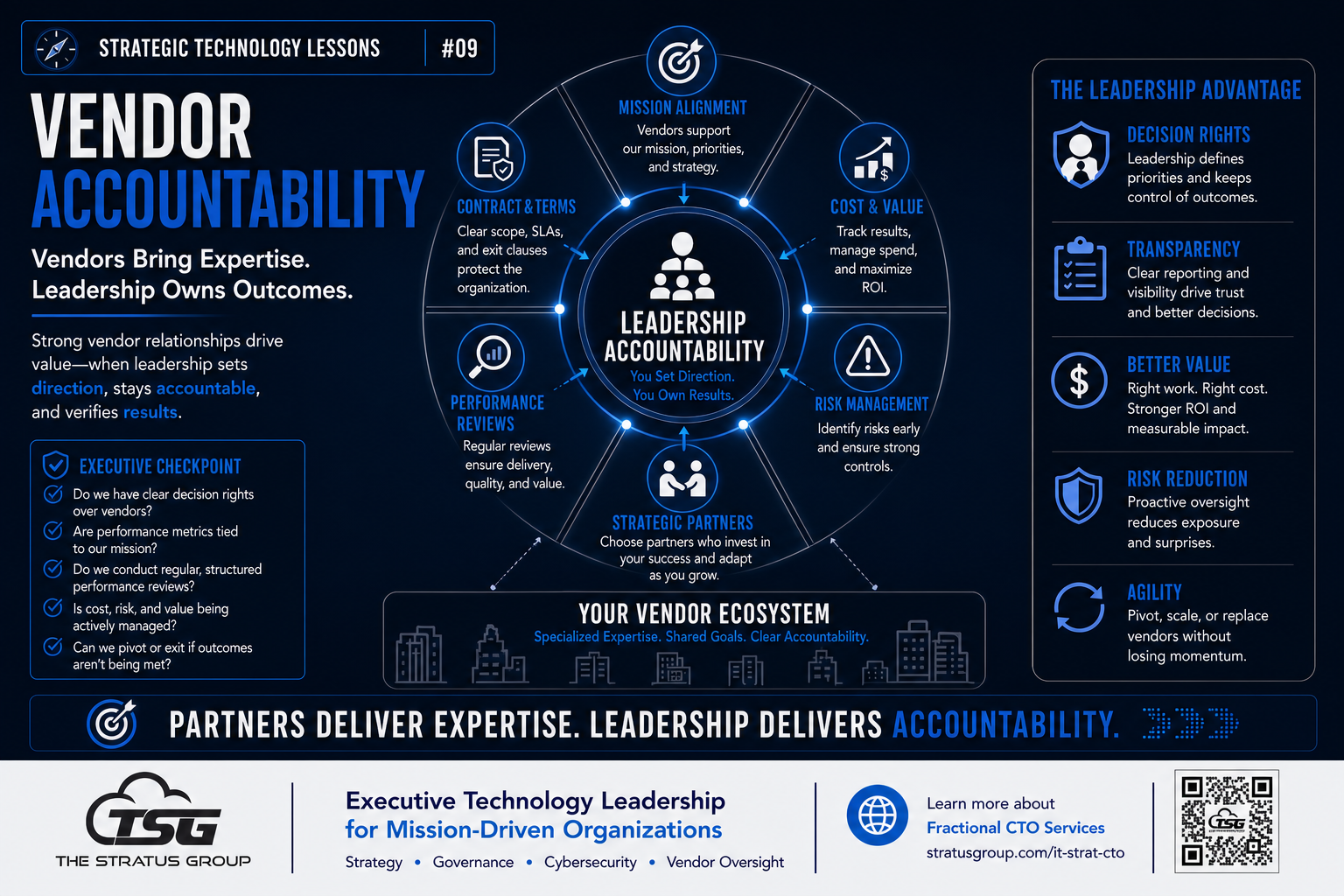
Vendor management is operational. Vendor accountability is executive leadership.
In Brief
Technology vendors are partners, not decision makers.
Their recommendations may be well-founded, but leadership remains responsible for determining whether those recommendations align with the organization's mission, priorities, budget, and risk tolerance.
Organizations with clear technology leadership receive greater value from every vendor relationship because someone is accountable for evaluating recommendations independently.
The Challenge
As technology environments become more complex, organizations often depend on multiple vendors that rarely share the same priorities.
One recommends a new security platform.
Another recommends migrating to the cloud.
Another promotes AI capabilities.
Each recommendation may be reasonable on its own.
Without executive oversight, however, organizations can accumulate disconnected initiatives that increase cost and complexity without advancing strategic goals.
The Difference Between Managing Vendors and Governing Vendors
Managing vendors includes:
Scheduling meetings
Reviewing invoices
Opening support tickets
Coordinating implementations
Tracking contracts
Governing vendors includes:
Evaluating recommendations
Aligning projects with the technology roadmap
Measuring business value
Holding vendors accountable for outcomes
Preventing unnecessary overlap
Protecting the organization's interests
Both activities matter, but they serve different purposes.
Questions Leadership Should Ask
Before approving a major technology recommendation, ask:
How does this support our strategic goals?
Does it align with our technology roadmap?
What business problem does it solve?
What alternatives were considered?
What are the long-term operational costs?
Who will measure success?
What risks are introduced or reduced?
These questions shift the conversation from products to outcomes.
The Role of a Fractional CTO
A Fractional CTO serves as the organization's independent technology advisor.
Responsibilities include:
Evaluating vendor recommendations
Coordinating technology strategy
Preventing unnecessary spending
Supporting executive decision-making
Ensuring accountability across vendors
Protecting long-term organizational interests
The objective is not to replace vendors.
It is to ensure every vendor contributes to a shared strategy.
Executive Technology Check
Ask your leadership team:
Who independently evaluates vendor recommendations?
Are technology purchases aligned with a documented roadmap?
Do we measure vendors by business outcomes or technical activity?
Can we explain why each major technology investment supports our mission?
Who represents the organization's interests during major technology decisions?
Key Takeaways
Vendors provide expertise; leadership provides direction.
Technology recommendations should always support organizational strategy.
Independent oversight improves vendor performance and accountability.
A Fractional CTO helps leadership make informed technology decisions.
Strong vendor relationships begin with clear executive governance.
Closing Thought
Your vendors should be trusted partners.
But no vendor should define your technology future.
That responsibility belongs to your organization's leadership.
Continue the Conversation
The Stratus Group helps mission-driven organizations strengthen vendor accountability through Fractional CTO leadership, governance, technology roadmaps, and independent executive guidance.
Learn more:
https://www.stratusgroup.com/it-strat-cto
Next in the Series
Strategic Technology Playbook #10 - Technology Metrics That Matter to the Board