
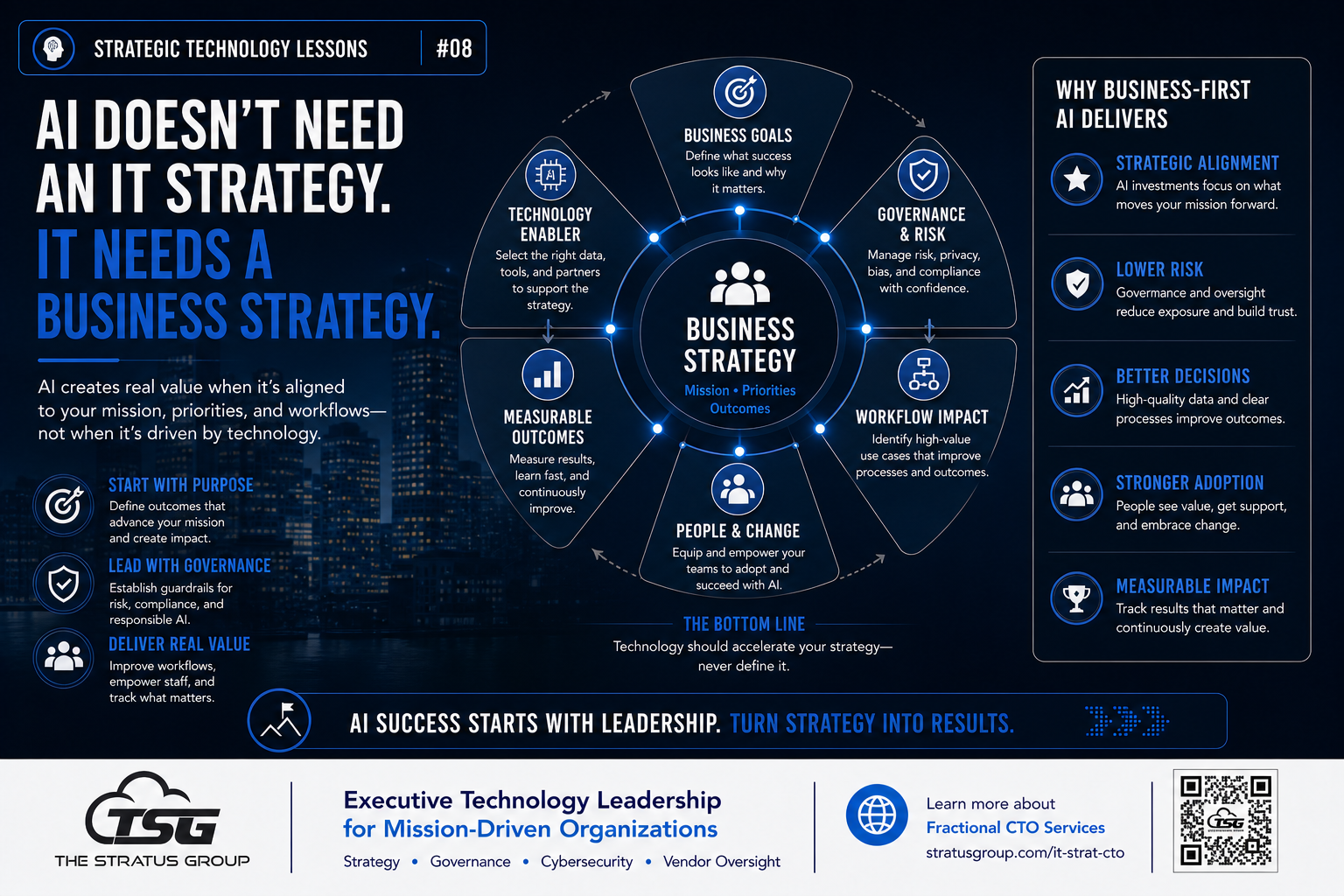
AI Doesn't Need an IT Strategy. It Needs a Business Strategy. - STL #8
Why Executive Leadership Must Lead AI Adoption
Artificial intelligence has become one of the most discussed technologies in decades.
Every week brings new tools, new promises, and new pressure to "do something with AI."
Many organizations respond by asking IT to evaluate products.
That skips the most important part of the conversation.
AI is not an IT initiative. It is a business initiative enabled by technology.
Before selecting a platform, leadership should decide what organizational outcomes AI should improve.
In Brief
Successful AI adoption begins with strategy, not software.
Teams that start with tools often end up with isolated pilots, inconsistent governance, and unclear returns.
Teams that start with business goals are far more likely to create measurable value.
Leadership should first answer:
What mission outcomes are we trying to improve?
Which processes consume the most staff time?
Where can AI increase quality, speed, or insight?
What risks must we manage?
How will we measure success?
Start With the Mission
AI should support organizational priorities such as:
Improving constituent services
Increasing staff productivity
Strengthening fundraising
Enhancing reporting
Reducing repetitive work
Improving decision-making
Technology follows strategy, not the other way around.
Governance Before Deployment
Before approving AI tools, leadership should establish:
Acceptable use policies
Data privacy requirements
Human oversight
Vendor evaluation criteria
Security expectations
Compliance requirements
Training plans
Strong governance builds trust and reduces organizational risk.
Avoid Common Mistakes
Many organizations:
Buy AI tools without defined objectives
Allow departments to adopt AI independently
Ignore data quality
Underestimate governance
Measure activity instead of outcomes
These mistakes create cost without delivering meaningful value.
A Practical AI Roadmap
Define business objectives.
Assess processes and data.
Identify high-value use cases.
Establish governance.
Launch a limited pilot.
Measure outcomes.
Scale successful initiatives.
Executive Technology Check
Do we have an AI strategy tied to organizational goals?
Who owns AI governance?
Which processes are our highest-value AI opportunities?
How will we measure business outcomes?
What policies are in place before broader adoption?
Key Takeaways
AI should begin with mission outcomes.
Leadership owns AI strategy. IT supports it, but does not own it alone.
Governance should precede deployment.
Small, measurable pilots outperform broad experimentation.
AI delivers the greatest value when aligned with organizational priorities.
Closing Thought
When a leadership team starts by asking, "Which AI tool should we buy?" it is jumping into the middle of the conversation.
The better question is:
"What organizational problem are we trying to solve?"
When leadership answers that question first, technology becomes an accelerator instead of a distraction.
Continue the Conversation
The Stratus Group helps mission-driven organizations develop practical AI strategies, governance frameworks, and implementation roadmaps through Fractional CTO services.
Learn more:
https://www.stratusgroup.com/it-strat-cto
Next in the Series
Strategic Technology Playbook #9 - Vendor Accountability: Who Represents Your Organization?