
Who Is Really Leading Your Technology? - STL #1
Helping mission-driven leaders understand the difference between technology support and technology leadership.
Most mission-driven leaders believe their technology is covered.
You have an MSP. Your staff can submit help desk tickets. Microsoft 365 is running. Backups are in place. Cybersecurity software is installed. On the surface, everything appears to be working.
So why does technology still feel reactive?
Why do projects stall, budgets grow unexpectedly, and leadership struggle to answer questions about technology risk or future investments?
The answer is often surprisingly simple:
Technology support isn't the same as technology leadership.
In Brief
Most mission-driven organizations invest in technology operations and technology platforms, but many unintentionally overlook technology leadership.
An MSP keeps systems running. A technology platform enables your staff to do their work. Technology leadership ensures every technology investment supports your mission, reduces organizational risk, and aligns with your long-term strategy.
Understanding the difference is the first step toward making technology a strategic asset rather than simply another operating expense.
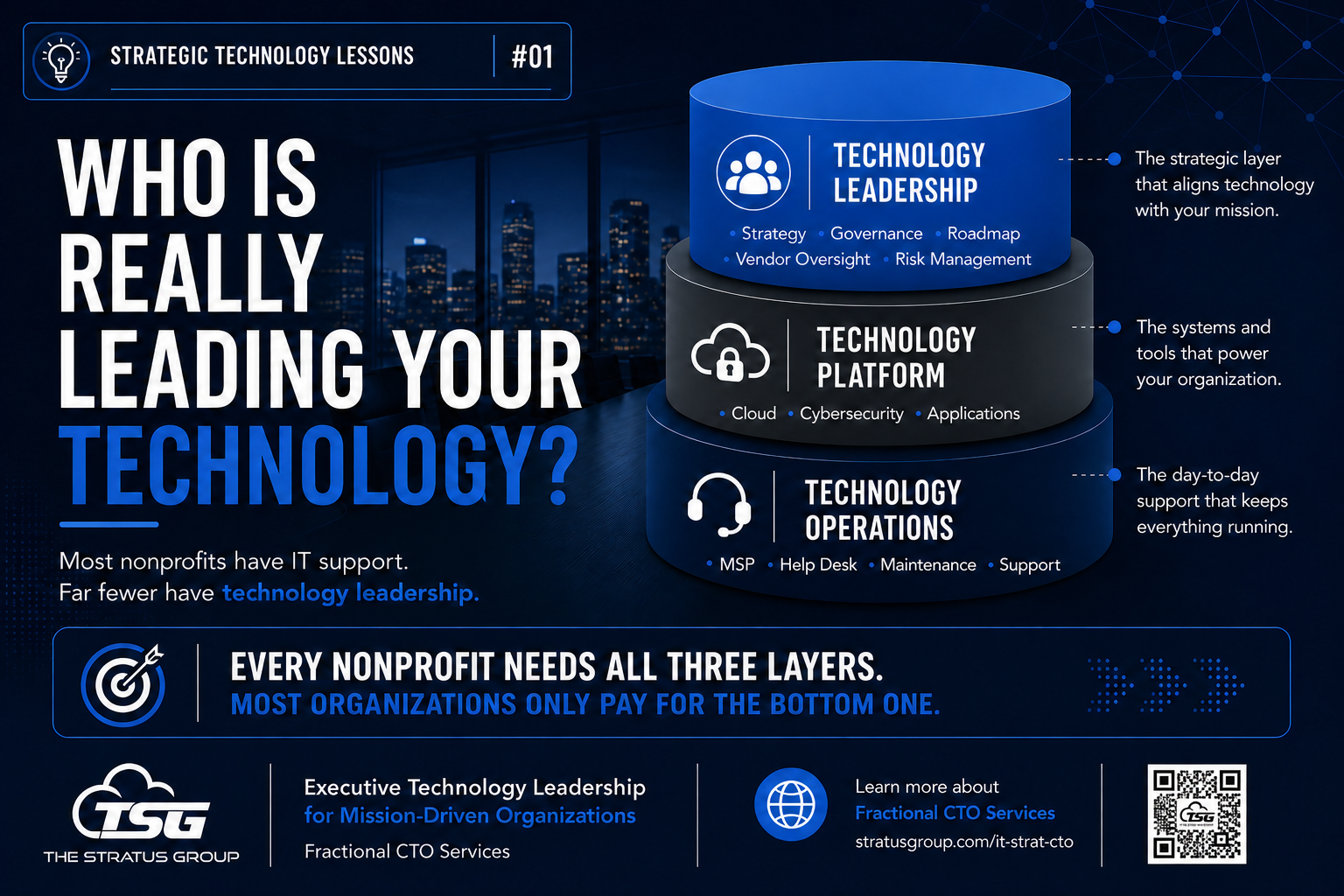
Every Mission-Driven Organization Needs Three Layers
Technology is more than computers, software, and cybersecurity. Every mission-driven organization depends on three distinct layers of technology working together.
Technology Operations
Technology Operations keeps your organization functioning every day.
This includes:
Help desk support
Device management
Network administration
System monitoring
Routine maintenance
User support
This is where your Managed Service Provider (MSP) excels. Their job is to keep technology available, secure, and reliable.
Without this layer, daily operations quickly grind to a halt.
Technology Platform
The next layer is your technology platform.
These are the systems your organization relies on to accomplish its mission.
Examples include:
Microsoft 365
Cloud infrastructure
Cybersecurity tools
Business applications
Backup and disaster recovery
AI tools and automation
These technologies enable productivity and collaboration.
However, technology tools alone do not create strategy.
Technology Leadership
At the top sits the layer many mission-driven organizations don't realize they're missing.
Technology Leadership focuses on executive decision-making rather than technical support.
It answers questions like:
Where should technology be taking our organization?
Which technology investments should we prioritize?
Are we spending wisely?
What risks should leadership and the board understand?
Are our vendors delivering value?
How does technology support our strategic plan?
These aren't technical questions.
They're executive leadership questions.
The Hidden Gap
Many mission-driven leaders naturally assume their MSP is handling technology leadership because they are the technology experts.
It's an understandable assumption.
However, most MSPs are designed to deliver operational excellence. Their expertise is keeping systems healthy, resolving issues, and maintaining technology.
That is an incredibly valuable role.
Technology leadership requires a different perspective.
It focuses less on how technology works and more on how technology advances your organization's mission.
Technology support keeps your organization running. Technology leadership determines where it's going.
It's the difference between maintaining the vehicle and deciding where you're driving.
Why This Matters
Without dedicated technology leadership, organizations often experience challenges that seem unrelated but share the same underlying cause.
Technology purchases become reactive instead of strategic.
Departments independently purchase software without coordination.
Budgets become difficult to predict.
Vendor recommendations go largely unquestioned.
Cybersecurity discussions focus on tools instead of organizational risk.
Technology projects compete for attention without clear priorities.
None of these issues necessarily indicate poor IT support.
They simply indicate that no one owns executive technology leadership.
Think of It This Way
Most mission-driven organizations already understand this distinction in other areas.
Your accounting firm prepares financial statements.
Your CFO develops financial strategy.
Your attorney provides legal counsel.
Your executive team makes organizational decisions.
Your MSP manages technology operations.
Someone still needs to provide technology leadership.
These roles complement one another---they don't replace each other.
What Technology Leadership Looks Like
Organizations with effective technology leadership typically have someone responsible for:
Developing a multi-year technology roadmap
Aligning technology investments with organizational priorities
Overseeing technology vendors and MSP performance
Advising executive leadership and the board
Managing technology risk and cybersecurity governance
Supporting budgeting and long-term planning
Evaluating emerging technologies such as AI
Technology becomes intentional rather than reactive.
Where a Fractional CTO Fits
Many mission-driven organizations don't need---or can't justify---a full-time Chief Technology Officer.
That doesn't mean they don't need technology leadership.
A Fractional CTO works alongside your MSP, providing executive guidance, governance, strategic planning, and vendor oversight.
Your MSP manages daily operations.
Your Fractional CTO ensures technology investments, priorities, and risks remain aligned with your mission and long-term goals.
It's executive technology leadership without the cost of a full-time executive.
Three Executive Questions
Ask yourself:
Do we have a documented technology roadmap aligned with our strategic plan?
Who independently evaluates the recommendations made by our MSP or technology vendors?
Can our leadership team clearly explain our technology priorities, risks, and investment strategy?
If these questions are difficult to answer, your organization may have a technology leadership gap.
Recognizing that gap is the first step toward ensuring technology becomes a strategic asset---not just another operational expense.
Continue the Conversation
Technology is one of the largest operational investments many mission-driven organizations make, yet many still don't have dedicated executive technology leadership.
If you're wondering whether your organization has a technology leadership gap, we'd be happy to help.
Schedule a complimentary 30-minute Executive Technology Consultation to discuss your technology strategy, vendor relationships, cybersecurity priorities, and long-term roadmap.
There is no obligation and no sales presentation---just practical executive guidance.
Learn more:https://www.stratusgroup.com/it-strat-cto
Next in Strategic Technology Playbook
Your MSP Isn't Your CTO
Understanding the Difference Between Technology Support and Technology Leadership.