
Your MSP Isn't Your CTO - STL #2
Why great IT support still does not replace technology leadership
Most mission-driven organizations hire a managed service provider because they need dependable technology support.
That is exactly what an MSP is designed to provide.
A good MSP keeps systems running, responds to support requests, manages infrastructure, monitors security tools, maintains devices, and helps employees stay productive.
Those services are essential.
But they are not the same as executive technology leadership.
Many organizations quietly assume that once an MSP is in place, someone is also setting technology priorities, evaluating major investments, aligning technology with the mission, overseeing vendors, and helping leadership make informed decisions.
Often, no one is.
That gap is where many organizations get stuck.
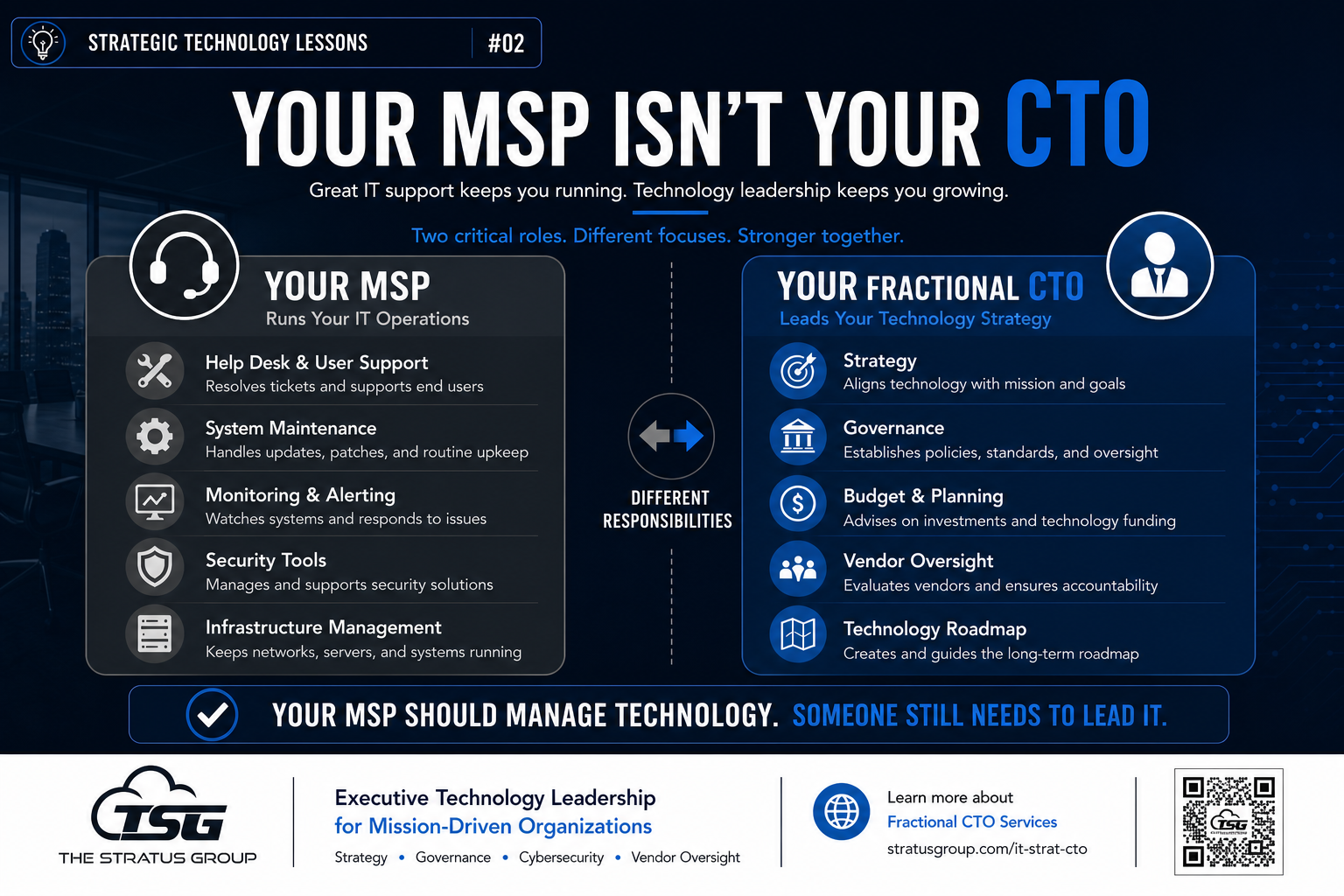
Your MSP manages technology operations. Your CTO leads technology strategy.
Neither role is more important than the other. They are simply responsible for different outcomes.
In Brief
An MSP provides operational expertise.
A CTO provides executive leadership.
Your MSP may be excellent at maintaining systems, resolving issues, implementing tools, and protecting infrastructure. But those responsibilities do not automatically include building a long-term technology roadmap, setting investment priorities, evaluating organizational risk, or advising executive leadership and the board.
Healthy organizations understand the distinction.
They do not ask the MSP to become something it was never hired to be. Instead, they create a leadership structure in which the MSP and the technology executive work together.
The MSP operates the environment.
The CTO ensures the environment supports the mission.
Why the Confusion Is So Common
The confusion is understandable.
Technology is complex, and MSPs are often the most visible technology experts in the organization. They answer questions, solve problems, make recommendations, and build trusted relationships with staff and leadership.
Over time, that trust can create the impression that the MSP owns the entire technology function.
But operational expertise and executive accountability are not the same thing.
An MSP may recommend a new security platform, cloud service, or infrastructure upgrade. Those recommendations may be sound. Yet someone inside the organization still needs to determine:
Whether the recommendation supports strategic priorities
Whether the cost is justified
Whether another approach would deliver greater value
Whether the investment fits the organization's risk tolerance
Whether the timing is right
Whether leadership and the board understand the implications
Those are not help desk questions.
They are executive questions.
What an MSP Is Designed to Do
A managed service provider is typically focused on the day-to-day operation of technology.
Depending on the agreement, an MSP may be responsible for:
Help desk and user support
Device management
Network and infrastructure maintenance
Cloud administration
Security monitoring
Backup management
Software deployment
Patch management
Vendor coordination
Technical troubleshooting
These responsibilities are critical. Without strong operational support, technology becomes unreliable, employees lose productivity, security risk increases, and leadership spends too much time reacting to preventable problems.
A capable MSP brings structure, consistency, specialized expertise, and scale.
But the MSP's primary responsibility is usually to deliver the services defined in its agreement.
That agreement does not necessarily make the MSP accountable for the organization's overall technology direction.
What a CTO Is Responsible For
A Chief Technology Officer, or a Fractional CTO for organizations that do not need a full-time executive, operates at a different level.
The CTO is responsible for connecting technology decisions to organizational goals.
That includes:
Establishing technology priorities
Building and maintaining a multi-year roadmap
Aligning technology investments with the mission
Developing governance and decision-making processes
Creating realistic technology budgets
Evaluating major vendors and recommendations
Identifying organizational and cybersecurity risks
Advising executive leadership
Supporting board-level oversight
Preparing the organization for emerging technologies such as artificial intelligence
The CTO is not simply another technical resource.
The role exists to help leadership make better decisions.
MSP and CTO: Different Responsibilities
Managed Service ProviderFractional CTOKeeps systems runningAligns technology with the missionResolves technical issuesSets prioritiesMaintains infrastructureBuilds the technology roadmapImplements toolsEvaluates investmentsSupports usersAdvises executivesMonitors systemsOversees risk and governanceDelivers technical servicesProvides organizational accountabilityOperates technologyLeads technology
The strongest technology environments include both capabilities.
The MSP delivers reliable operations.
The CTO provides direction, oversight, and accountability.
The Risk of Leaving the Leadership Role Unfilled
When no one owns technology leadership, decisions still get made.
They are simply made without a clear framework.
Different departments may purchase overlapping tools. Vendors may drive priorities. Budgets may be based on the previous year's spending rather than future needs. Cybersecurity may be treated as a collection of products instead of an organizational risk. Technology projects may begin without clear ownership or measurable outcomes.
Over time, this creates a reactive environment.
The organization may have competent IT support while still experiencing:
Unclear technology priorities
Unexpected costs
Duplicated systems
Weak vendor accountability
Inconsistent security decisions
Projects that stall or fail
Limited executive visibility
No shared technology roadmap
None of these problems necessarily indicate that the MSP is performing poorly.
They often indicate that the organization has left the executive technology role unfilled.
An Independent Leadership Perspective Matters
There is another reason the roles should remain distinct.
Your organization needs someone who can independently evaluate technology recommendations.
An MSP may recommend services that it also sells, implements, or manages. That does not mean the recommendation is inappropriate. It simply means leadership should have an informed person who can assess the recommendation from the organization's perspective.
A Fractional CTO can ask:
Is this the right solution for our needs?
Is the proposed scope appropriate?
Are the costs competitive?
What alternatives should we consider?
What organizational changes are required?
How does this affect our long-term roadmap?
What risks are reduced, and what risks remain?
This independent perspective strengthens the relationship with the MSP.
It creates clearer expectations, better decisions, and greater accountability for everyone involved.
Your MSP Should Be a Partner, Not the Strategy Owner
The goal is not to reduce the role of the MSP.
It is to make the relationship more effective.
When a technology leader is in place, the MSP receives clearer priorities, faster decisions, better-defined projects, and stronger executive support.
The CTO establishes direction.
The MSP helps execute it.
This partnership allows each party to focus on what it does best.
A healthy model looks like this:
Executive leadership defines organizational goals.
The CTO translates those goals into technology priorities.
The MSP provides operational expertise and implementation support.
The CTO oversees progress, risk, investment, and accountability.
Leadership receives clear reporting and can make informed decisions.
This is far more effective than expecting the MSP to define, approve, execute, and evaluate the organization's technology strategy.
A Useful Comparison
Expecting your MSP to function as your CTO is like expecting your accounting firm to serve as your CFO. Both are valuable. They simply solve different problems.
An accounting firm may prepare financial statements, handle tax matters, and provide specialized expertise.
A CFO uses financial information to guide organizational decisions, manage risk, establish priorities, and advise leadership.
The same distinction applies to technology.
Your MSP delivers essential services.
Your CTO ensures those services support the organization's larger goals.
Signs That Your Organization Needs Technology Leadership
Your organization may need a Fractional CTO if:
Technology decisions are primarily driven by vendors
No one owns a multi-year technology roadmap
Leadership is unsure whether technology spending is appropriate
Major projects lack clear executive accountability
Cybersecurity is discussed only as a technical issue
The board receives little or no technology reporting
Departments purchase systems independently
Your MSP is regularly asked to make organizational decisions
Technology priorities change whenever a new problem appears
No one is preparing the organization for AI and other emerging technologies
These are not signs that your organization needs more help desk capacity.
They are signs that it needs leadership.
Executive Technology Check
Ask your leadership team three questions:
Who owns our technology roadmap?
Who independently evaluates recommendations from our MSP and other vendors?
Who reports technology priorities, investments, and risks to executive leadership and the board?
If the answers are unclear, or if the answer to every question is the MSP, your organization may have strong technology support but no true technology leader.
Key Takeaways
An MSP and a CTO perform different roles.
Operational support does not replace executive accountability.
Your MSP should not be expected to define and independently evaluate your technology strategy.
A Fractional CTO helps leadership establish priorities, manage risk, oversee vendors, and align investments with the mission.
The strongest model is not MSP or CTO. It is MSP and CTO, working together.
Continue the Conversation
The Stratus Group helps mission-driven organizations build practical technology strategies, strengthen vendor accountability, improve governance, and make better technology investments.
Our Fractional CTO services provide executive-level technology leadership without the cost or commitment of a full-time technology executive.
Learn more at:
https://www.stratusgroup.com/it-strat-cto
Next in the Series
Strategic Technology Playbook #3 - The Three Layers of Every Technology Organization
The next article will examine the three capabilities every healthy technology organization needs: executive leadership, a reliable technology platform, and strong day-to-day operations.