
The Three Layers of Every Technology Organization - STL #3
What a healthy technology organization actually looks like
Most organizations think about technology as a collection of tools, systems, vendors, and support services.
They ask whether the help desk is responsive, whether the network is reliable, whether cybersecurity tools are in place, and whether staff can access the applications they need.
Those questions matter.
But they describe only part of the technology function.
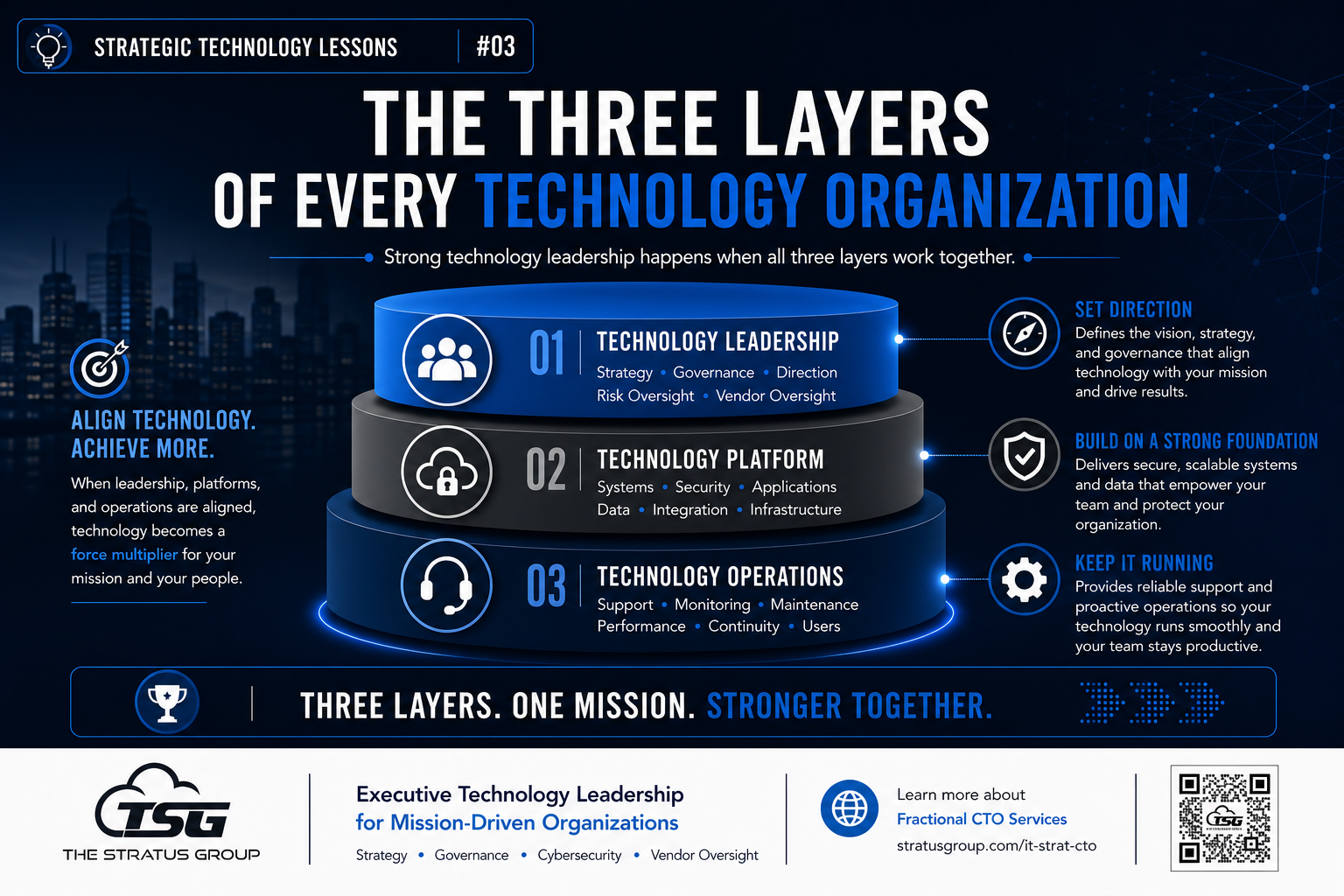
A healthy technology organization depends on three distinct layers:
Technology Leadership
Technology Platform
Technology Operations
Each layer serves a different purpose.
Each requires different skills.
And each must work with the others.
When one layer is missing, the organization may still function, but it will struggle to make technology reliable, secure, strategic, and aligned with its mission.
Strong technology organizations do not rely on a single provider, platform, or person. They align leadership, systems, and operations around shared goals.
In Brief
Every organization needs three technology capabilities.
Technology Leadership sets direction, establishes priorities, manages risk, and aligns investments with the mission.
Technology Platform includes the systems, applications, infrastructure, cloud services, data, and cybersecurity controls that power the organization.
Technology Operations provides the day-to-day support, maintenance, monitoring, and administration needed to keep everything running.
Many organizations invest heavily in the platform and operations layers while leaving leadership undefined.
What you get is dependable support, but no clear roadmap, weak governance, unclear ownership, and spending that drifts away from strategy.
A mature organization understands that all three layers are essential.
Layer One: Technology Leadership
Technology leadership sits at the strategic layer.
It determines where technology should go, why particular investments matter, how risks should be managed, and how technology can better support the organization's goals.
This layer is responsible for questions such as:
What are our technology priorities?
Which investments will best advance the mission?
What risks require executive attention?
How should we govern cybersecurity, data, and artificial intelligence?
Which vendors should we trust?
What should our technology budget include?
How should we explain technology priorities to the board?
What capabilities will the organization need in the next three years?
Technology leadership typically includes:
Strategy
Governance
Roadmap development
Budget planning
Vendor oversight
Risk management
Executive advising
Board reporting
Policy development
Business alignment
For many mission-driven organizations, a Fractional CTO is the most practical way to fill this role.
A Fractional CTO provides executive-level leadership without requiring the cost or commitment of a full-time technology executive.
The leadership layer does not replace technical experts.
It gives them direction.
Layer Two: Technology Platform
The technology platform is the foundation of systems and tools that power the organization.
It includes the environment employees use every day and the infrastructure that supports the mission.
The platform may include:
Cloud services
Business applications
Collaboration tools
Data systems
Networks
Servers
End-user devices
Identity and access management
Cybersecurity tools
Backup and recovery systems
Integration platforms
Reporting and analytics
A strong platform should be reliable, secure, supportable, and appropriate for the organization's needs.
But owning modern tools does not automatically create a healthy technology environment.
The platform must be selected, configured, integrated, governed, and maintained well.
Without leadership, organizations often accumulate tools reactively.
One department chooses one application. Another department selects a competing system. A vendor adds a security product. A new cloud service is introduced to solve an immediate problem.
Over time, the platform becomes fragmented, expensive, difficult to support, and hard to secure.
The platform layer answers:
What technology do we use?
The leadership layer answers:
Why are we using it, and what outcomes should it produce?
Layer Three: Technology Operations
Technology operations is the day-to-day service layer.
It keeps systems functioning, supports employees, resolves issues, monitors the environment, and performs routine maintenance.
This layer often includes:
Help desk support
User onboarding and offboarding
Device management
Patch management
Account administration
Network monitoring
Backup monitoring
Security alert response
Application support
Infrastructure maintenance
Technical troubleshooting
Vendor coordination
An MSP commonly provides much of this capability.
Strong operations are essential.
Without them, technology becomes unreliable, employees lose productivity, small issues become major disruptions, and leadership is pulled into technical problems that should be handled elsewhere.
Operations answers:
How do we keep technology working every day?
It does not necessarily answer:
Are we investing in the right technology?
That is why operations alone cannot carry the full technology function.
How the Three Layers Work Together
The three layers are most effective when they operate as a coordinated system.
Technology Leadership
Defines direction, priorities, policies, risk tolerance, and expected outcomes.
Technology Platform
Provides the systems, applications, infrastructure, data, and security capabilities required to support those priorities.
Technology Operations
Maintains, monitors, supports, and administers the platform so employees can use it effectively.
A healthy sequence looks like this:
Leadership defines organizational goals.
Technology leadership translates those goals into a roadmap.
The platform is designed or improved to support the roadmap.
Operations maintains and supports the platform.
Performance, risk, and outcomes are reviewed.
Leadership adjusts priorities as the organization changes.
When the layers are aligned, technology becomes more predictable and more valuable.
When they are disconnected, the organization becomes reactive.
What Happens When a Layer Is Missing
Each missing layer creates a different type of problem.
When Technology Leadership Is Missing
The organization may have reliable systems and responsive support but no shared direction.
Common symptoms include:
Vendors driving priorities
No documented roadmap
Reactive budgeting
Weak governance
Limited board visibility
Projects without executive ownership
Security decisions made tool by tool
Technology investments disconnected from strategy
When the Technology Platform Is Weak
Leadership may have good ideas, but the underlying systems cannot support them.
Common symptoms include:
Outdated applications
Poor integration
Unreliable infrastructure
Data silos
Weak access controls
Limited reporting
Duplicate systems
High technical debt
When Technology Operations Are Weak
The organization may have modern tools and a sound strategy, but daily execution breaks down.
Common symptoms include:
Slow support
Unresolved issues
Inconsistent onboarding
Missed updates
Weak monitoring
Poor documentation
Recurring outages
Staff frustration
The lesson is simple:
No single layer can compensate indefinitely for the absence of another.
Why Organizations Overinvest in the Bottom Layer
Most organizations recognize operational problems quickly.
Employees cannot log in.
A laptop fails.
An application stops working.
A security alert appears.
These issues are immediate, visible, and disruptive, so organizations naturally invest in help desk support, maintenance, monitoring, and infrastructure.
Leadership gaps are harder to see.
A missing roadmap does not create a flashing alert.
Weak governance may not become obvious until a major decision goes wrong.
Poor vendor oversight may remain hidden for years.
Misaligned spending may appear normal because the bills are being paid and the systems still work.
As a result, many organizations fund the operations layer and part of the platform layer while assuming leadership will somehow emerge from the same arrangement.
Usually, it does not.
Technology Leadership Is Not an Extra Layer
Some organizations treat technology leadership like a luxury that only large institutions can afford.
That is a mistake.
Smaller organizations may need technology leadership even more because they have fewer resources, less room for failed investments, and greater dependence on outside vendors.
Size is not the real issue.
The real question is whether technology decisions affect:
Mission delivery
Financial sustainability
Organizational risk
Staff productivity
Data privacy
Cybersecurity
Donor trust
Compliance
Executive accountability
For most organizations, the answer is yes.
A Fractional CTO makes this leadership layer practical by providing the right level of executive involvement without requiring a full-time position.
A Simple Operating Model
A practical division of responsibility may look like this:
LayerPrimary PurposeTypical OwnerTechnology LeadershipDirection, governance, risk, investment, accountabilityFractional CTO or internal technology executiveTechnology PlatformSystems, applications, infrastructure, data, cybersecurity controlsInternal team, MSP, vendors, and application ownersTechnology OperationsSupport, monitoring, maintenance, administrationMSP, help desk, or internal IT staff
The exact ownership will vary.
The important point is that every responsibility has a clear owner and every layer is connected to the others.
Questions Every Executive Team Should Ask
To evaluate the health of your technology organization, ask:
Leadership
Do we have a documented technology roadmap?
Are technology priorities tied to organizational goals?
Who owns technology risk?
Who evaluates vendors and major recommendations?
Does the board receive meaningful technology reporting?
Platform
Are our systems reliable, secure, and well integrated?
Do we have unnecessary duplication?
Can leadership access accurate information?
Are our tools appropriate for our current and future needs?
Are data, identity, and access governed consistently?
Operations
Do employees receive timely support?
Are systems monitored and maintained consistently?
Are onboarding and offboarding processes reliable?
Are technical responsibilities documented?
Can recurring issues be identified and reduced?
A weakness in any section deserves attention.
The Goal: Mission-Enabled Technology
The purpose of this framework is not to create more technology bureaucracy.
It is to ensure technology supports the organization instead of distracting from it.
When all three layers are working together:
Leadership has visibility
Employees receive dependable support
Vendors have clear direction
Investments are better prioritized
Risks are easier to manage
Projects have stronger ownership
Systems are more consistent
Technology becomes a force multiplier for the mission
That is the difference between having IT support and building a healthy technology organization.
Executive Technology Check
Ask your leadership team:
Who is responsible for each of the three layers in our organization?
Which layer receives the most attention and funding today?
Where are responsibilities unclear, duplicated, or missing?
Do our platform and operations decisions follow a defined technology strategy?
Can leadership explain how technology investments support the mission?
If the organization cannot answer these questions clearly, the problem may not be a lack of technology.
It may be a lack of structure.
Key Takeaways
Every healthy technology organization depends on leadership, platform, and operations.
The three layers require different skills, responsibilities, and forms of accountability.
MSPs commonly support the operations layer and parts of the platform layer.
Executive technology leadership must still be clearly assigned.
Reliable systems are not enough if priorities, governance, and investment decisions remain unclear.
The goal is not more technology. The goal is technology that reliably advances the mission.
Continue the Conversation
The Stratus Group helps mission-driven organizations strengthen all three layers of their technology environment.
Our Fractional CTO services provide executive leadership, governance, roadmap development, vendor oversight, cybersecurity guidance, and investment planning. We work alongside your MSP and other technology partners.
Learn more at:
https://www.stratusgroup.com/it-strat-cto
Next in the Series
Strategic Technology Playbook #4 - The Hidden Cost of Reactive IT
The next article will examine the visible and hidden costs of reactive technology, including missed opportunities, poor planning, vendor sprawl, unnecessary risk, and leadership distraction.