
The Hidden Cost of Reactive IT - STL #4
Why Solving Today's Problems Often Creates Tomorrow's Challenges
Every mission-driven leader understands the value of planning.
Organizations budget before they spend. They develop fundraising strategies before launching campaigns. They prepare for audits before auditors arrive.
Technology works the same way.
Yet many organizations unknowingly manage technology almost entirely through reaction.
A server fails. A cyber insurance requirement changes. A department needs a new application. A security incident exposes a weakness. Leadership approves another urgent purchase.
Each decision seems reasonable.
Collectively, they create an organization that is always responding and rarely steering.
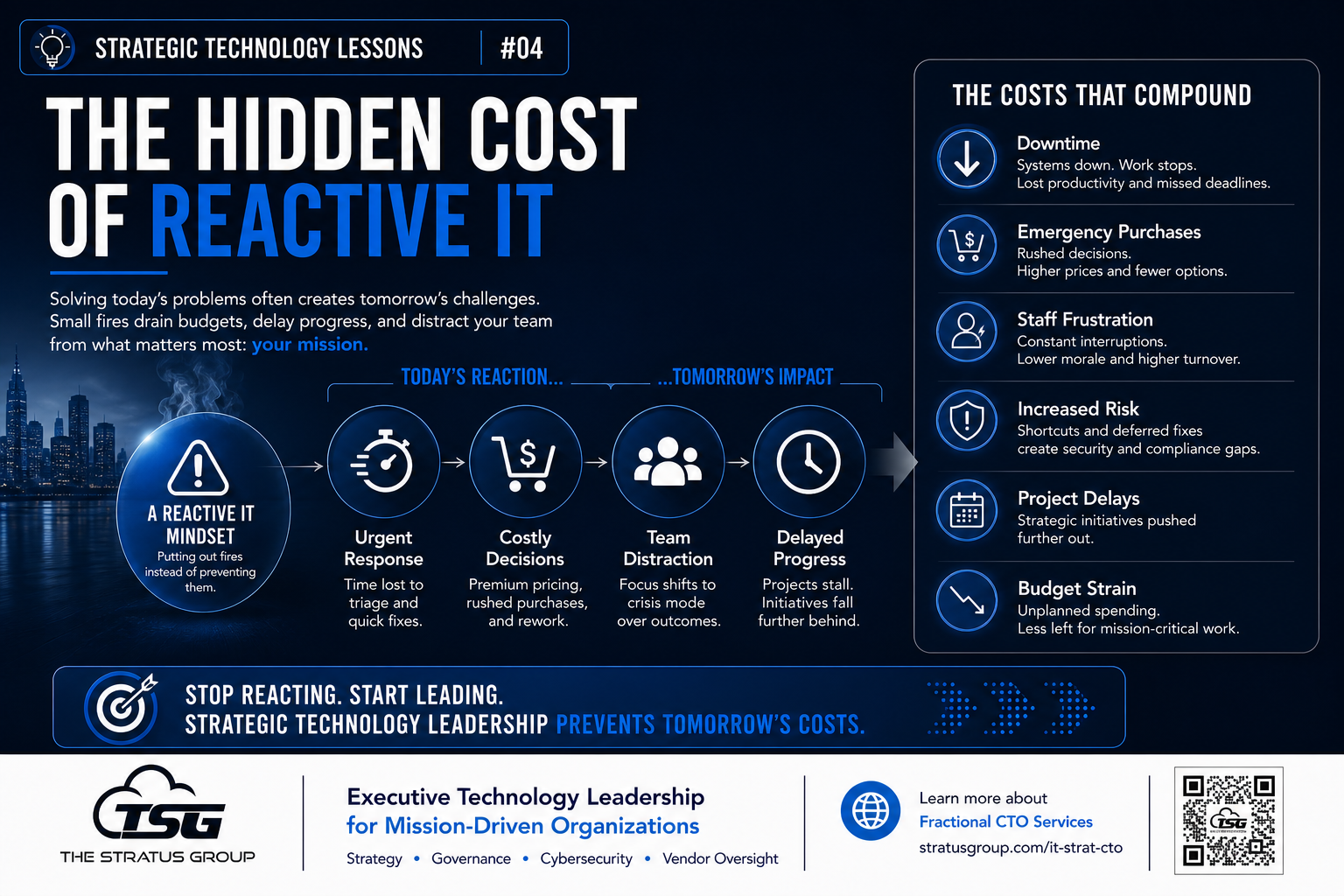
Reactive IT solves today's problems. Strategic technology leadership prevents tomorrow's.
In Brief
Reactive IT is not simply about emergencies.
It is a pattern of decision-making where technology priorities are driven by urgency instead of strategy.
The visible costs are easy to recognize:
Downtime
Help desk tickets
Emergency purchases
Hardware failures
Those are only the tip of the iceberg.
Below the surface lie the costs that have the greatest impact on an organization's mission:
Lost productivity
Executive distraction
Technical debt
Vendor dependence
Security risk
Budget waste
Delayed initiatives
Missed opportunities
Organizations rarely struggle because of one bad technology decision.
They struggle because hundreds of reactive decisions slowly replace strategic planning.
The Iceberg Beneath the Surface
Most executives see the visible costs because they interrupt the workday.
Employees cannot log in.
A server fails.
The network goes offline.
Emergency invoices arrive.
Those problems demand immediate attention.
But they are only the part above the waterline.
The much larger costs remain hidden.
Executive Distraction
Leadership meetings become crisis meetings.
Time that should be spent advancing the mission is consumed by urgent technology decisions.
Lost Productivity
Employees invent workarounds, repeat tasks, and wait for issues to be resolved.
The lost time rarely appears on a financial statement, but it affects every department.
Technical Debt
Deferred upgrades and short-term fixes accumulate until routine maintenance becomes expensive modernization.
Vendor Dependence
Without a roadmap, vendors naturally begin influencing priorities.
Recommendations may be well intentioned, but they are not a substitute for organizational strategy.
Missed Opportunities
Artificial intelligence, automation, data analytics, and digital transformation are delayed because leadership is focused on keeping today's systems running.
A Familiar Story
Imagine a mission-driven organization putting off an aging storage replacement because the budget is tight.
Six months later the storage system fails.
Employees lose access to shared files.
An emergency consultant is called.
Replacement hardware is rushed into production.
Projects stop.
Leadership spends the next board meeting explaining a crisis that could have been avoided.
The invoice reflects the emergency repair.
It does not reflect:
Lost staff productivity
Delayed strategic initiatives
Executive time
Donor confidence
Opportunity cost
Those are the hidden costs.
Moving From Reactive to Strategic
Reactive organizations often follow this cycle:
Problem → Purchase → Temporary Relief → Next Problem
Strategic organizations follow a different path:
Mission → Strategy → Roadmap → Investment → Implementation → Continuous Improvement
The difference is not better technology.
The difference is better leadership.
Executive Technology Check
Ask your leadership team:
Which technology initiatives were planned, and which were emergency responses?
What projects have been delayed because urgent issues consumed resources?
Who decides technology priorities before vendors make recommendations?
Are technology investments connected to a documented roadmap?
If nothing broke next month, what strategic technology work would we accomplish?
Key Takeaways
The biggest costs of reactive IT are usually invisible.
Emergency spending is only a symptom.
Lost productivity, technical debt, and executive distraction create larger long-term costs.
Technology leadership shifts organizations from reacting to planning.
Intentional decisions consistently outperform urgent decisions.
Closing Thought
Organizations rarely become reactive overnight.
They become reactive one urgent decision at a time.
Likewise, organizations become strategic one intentional decision at a time.
Technology leadership means making those decisions before urgency makes them for you.
Continue the Conversation
The Stratus Group helps mission-driven organizations replace reactive technology management with strategic technology leadership through Fractional CTO services.
Learn more:
https://www.stratusgroup.com/it-strat-cto
Next in the Series
Strategic Technology Playbook #5 - Technology Debt Is Financial Debt