
Why Deferred Technology Decisions Create Real Financial Liabilities
When executives hear the word debt, they immediately think about obligations that must eventually be repaid.
Technology debt works the same way.
Every time an organization postpones replacing aging systems, delays cybersecurity improvements, extends unsupported software, or defers infrastructure investments, it takes on an obligation that does not disappear. It simply becomes more expensive over time.
The decision may improve this year's budget.
It often makes next year's budget and the organization's risk profile worse.
Technology debt earns interest. The payments simply arrive as downtime, emergency spending, lost productivity, and increased organizational risk.
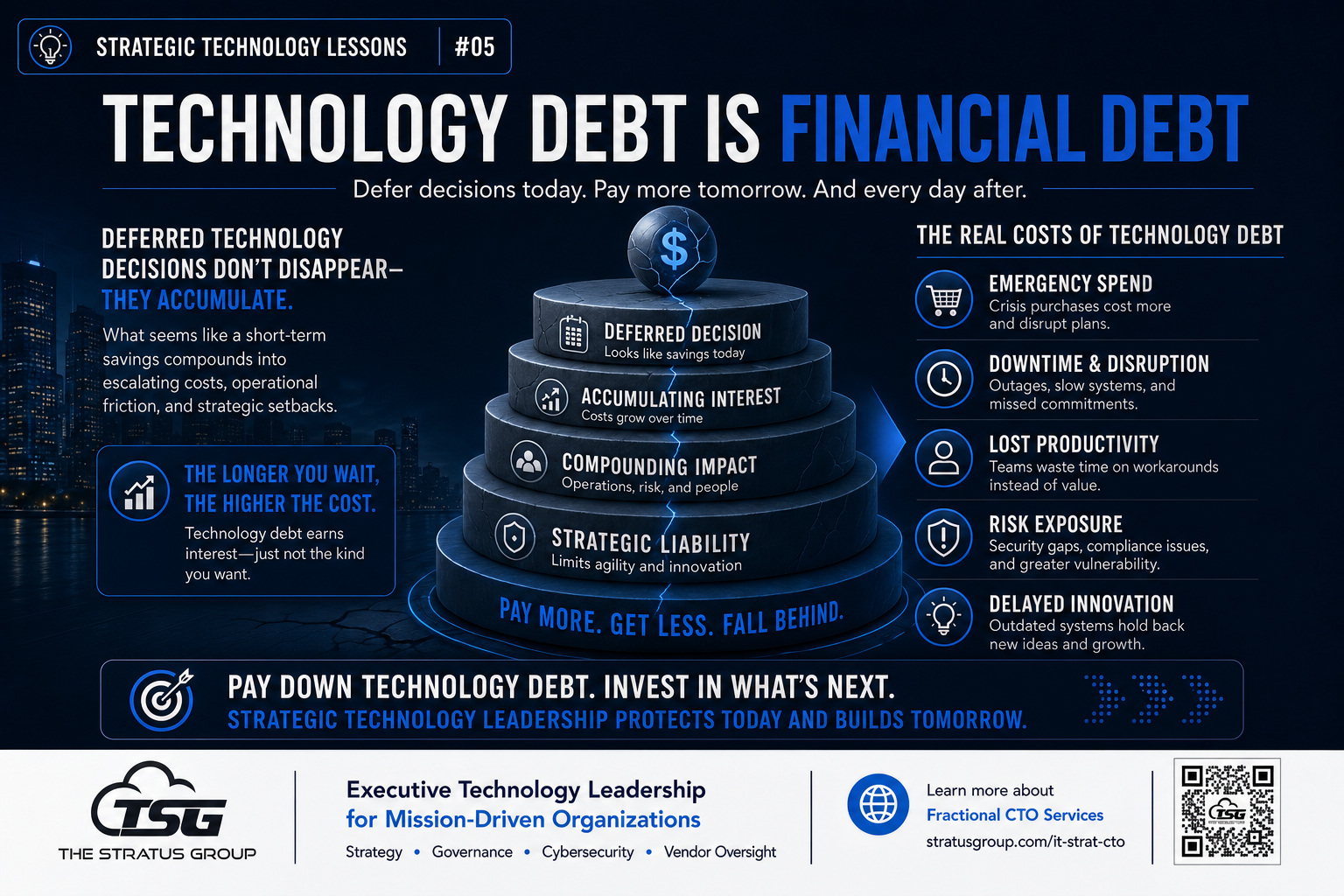
Summary graphic; full explanation follows below.
In Brief
Technology debt is the accumulation of deferred technology decisions that increase future cost, complexity, and risk.
Unlike a financial loan, there is no monthly statement reminding leadership that the balance is growing.
Instead, organizations pay the interest through:
Emergency projects
Higher support costs
Aging infrastructure
Security exposure
Lost productivity
Delayed innovation
Vendor lock-in
Executive distraction
Healthy organizations manage technology debt intentionally, just as they manage financial debt.
What Is Technology Debt?
Technology debt is created whenever today's convenience is chosen over tomorrow's sustainability.
Examples include:
Delaying hardware replacement
Continuing to use unsupported software
Skipping cybersecurity improvements
Postponing infrastructure modernization
Creating manual workarounds instead of permanent solutions
Integrating "just one more" application without a long-term plan
None of these decisions are necessarily wrong.
The problem occurs when they accumulate without a strategy to repay them.
The Interest Payments
Technology debt rarely appears as a single expense.
Instead, it shows up in many small ways.
Operational Interest
More outages
Slower systems
Longer support times
Recurring issues
Financial Interest
Emergency purchases
Premium consulting
Duplicate software
Rising maintenance costs
Strategic Interest
Delayed projects
Missed innovation
AI initiatives postponed
Reduced organizational agility
Risk Interest
Cybersecurity exposure
Compliance challenges
Unsupported platforms
Higher cyber insurance costs
A Familiar Example
A mission-driven organization puts off replacing five-year-old servers to avoid a capital expense.
For another year, everything seems fine.
Then failures begin.
Staff lose productivity. Emergency consultants are called. Replacement equipment must be purchased immediately instead of competitively. Planned initiatives are delayed while IT focuses on recovery.
The organization saved money once.
It paid for that decision many times.
Paying Down Technology Debt
Technology debt should be managed, not ignored.
Executive leadership can reduce it by:
Maintaining a multi-year technology roadmap
Planning lifecycle replacements
Budgeting proactively
Measuring technical debt annually
Prioritizing cybersecurity investments
Reviewing vendor recommendations strategically
Aligning investments with organizational goals
The objective is not to eliminate every technology liability overnight.
It is to prevent debt from growing faster than the organization can manage it.
Executive Technology Check
Ask your leadership team:
Have we identified our largest sources of technology debt?
Which systems are operating beyond their intended lifecycle?
Are deferred technology projects documented?
What is our plan to reduce technology debt over the next three years?
Are we investing strategically, or are we simply delaying inevitable costs?
Key Takeaways
Technology debt is a financial liability, even if it never appears on the balance sheet.
Deferred technology decisions usually become more expensive over time.
The interest is paid through higher costs, lower productivity, and greater organizational risk.
Executive technology leadership helps organizations manage technology debt before it limits growth.
Technology should be treated as a long-term organizational asset, not a series of short-term expenses.
Closing Thought
Every organization carries some technology debt.
The issue is not whether it exists.
The issue is whether leadership understands it, measures it, and has a real plan to reduce it.
Organizations that manage technology debt intentionally protect both their finances and their mission.
Continue the Conversation
The Stratus Group helps mission-driven organizations align technology investments with long-term organizational goals through Fractional CTO services, governance, roadmaps, and executive technology leadership.
Learn more:
https://www.stratusgroup.com/it-strat-cto
Next in the Series
Strategic Technology Playbook #6 - Technology Roadmaps: Why Every Organization Needs a Direction Before the Next Investment